Thoughts on the American Project at 250
Whilst the 4th July has long been held to mark American Independence Day, it was on the 2nd that the 13 colonies unanimously passed the Lee Resolution at the Second Continental Congress and, with it, announced their independence from Britain. It was on the 4th July 1776 that they issued their justification for that act, the Declaration of Independence. Yet on the 3rd July, John Adams, the future second US President, wrote to his wife Abigail of how he expected history to treat the events of the preceding day:
“The Second Day of July 1776, will be the most memorable Epocha, in the History of America. I am apt to believe that it will be celebrated, by succeeding Generations, as the great anniversary Festival. It ought to be commemorated, as the Day of Deliverance by solemn Acts of Devotion to God Almighty. It ought to be solemnized with Pomp and Parade, with Shews, Games, Sports, Guns, Bells, Bonfires and Illuminations from one End of this Continent to the other from this Time forward forever more.”[i]
This article sets out some of my thoughts on the American Project at 250, and why the Founders’ vision mattered, and continues to matter not just for Americans but for the whole world. And, as 2 July 2026 dawns, I want to wish a very happy Independence Day to all my American friends!
American Independence: 250 years old today!
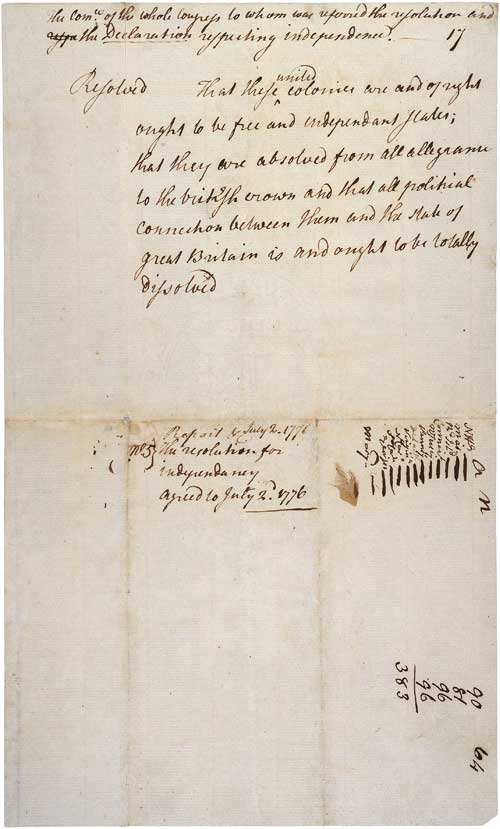
This year’s Independence Day is very special for it marks the 250th anniversary of that momentous July day in Philadelphia when the Second Continental Congress unanimously agreed Richard Henry Lee’s resolution:
“That these United Colonies are, and of right ought to be, free and independent States, that they are absolved from all allegiance to the British Crown, and that all political connection between them and the State of Great Britain is, and ought to be, totally dissolved.”[ii]
In his letter of 3 July to Abigail, Adams went on to describe how he was “well aware of the Toil and Blood and Treasure, that it will cost Us to maintain this Declaration, and support and defend these States.”[iii] Yet he was supremely confident that the many benefits of American liberty and independence would significantly outweigh the costs necessary to secure it:
“Yet through all the Gloom I can see the Rays of ravishing Light and Glory. I can see that the End is more than worth all the Means. And that Posterity will tryumph in that Days Transaction, even altho We should rue it, which I trust in God We shall not.”[iv]
I do find it fascinating (and, as someone who works in public affairs, mildly amusing) that Americans have made the 4 July their national holiday – the day that the Founders issued their press release announcing Independence! Thus:
“When in the Course of human events, it becomes necessary for one people to dissolve the political bands which have connected them with another, … a decent respect to the opinions of mankind requires that they should declare the causes which impel them to the separation.”[v]
For much more on ‘was it the 2nd or the 4th July?’, do check out Pauline Maier’s superb American Heritage article “Making Sense of the Fourth of July”.[vi] And my thanks to David Cutler for his article “Opinion: Independence Day on July 2? John Adams got it right”[vii]
The Declaration of Independence – aka the world’s most revered press release
The Declaration of Independence is rightly revered as one of humankind’s greatest instruments in the cause of liberty, limited government, and individual rights.
“We hold these truths to be self-evident, that all men are created equal, that they are endowed by their Creator with certain unalienable Rights, that among these are Life, Liberty and the pursuit of Happiness.”
The Declaration lays out the Founders’ distinctive social contract approach to government and the legitimacy of the state and its powers: to serve the people. Where a government ceases to do this, then the people can seek change up to, and including, revolution.
“That to secure these rights, Governments are instituted among Men, deriving their just powers from the consent of the governed, –That whenever any Form of Government becomes destructive of these ends, it is the Right of the People to alter or to abolish it, and to institute new Government, laying its foundation on such principles and organizing its powers in such form, as to them shall seem most likely to effect their Safety and Happiness.”
Moreover, government should not and cannot be upended on a whim. The Declaration explains that there must be a conspiracy or enterprise to violate not just alienable rights (such as my right to own a piece of property) but inalienable rights (that is, my right to own property per se). After all, we could have agreed in the social contract to pay some part of our (alienable) rights as taxes or service every year to fund the government; but we could never have agreed to give up any of our inalienable rights. Thus, the Declaration notes:
“But when a long train of abuses and usurpations, pursuing invariably the same Object evinces a design to reduce them under absolute Despotism, it is their right, it is their duty, to throw off such Government, and to provide new Guards for their future security.”
The ‘right to revolution’ laid out in the Declaration of Independence was not new with the Founders; it was an established part of that liberalism that traces back from the Founders through the pamphleteers John Trenchard and Thomas Gordon, who wrote Cato’s Letters, to the philosopher John Locke to John Lilburne and Richard Overton, leaders of the Levellers during the English Civil War, and to many others.[viii]
Dr Martin Luther King, Jr., and the universalism of the American Promise
The Declaration of Independence has its flaws, not least that it was penned in large part by a slave owner, allowed for human bondage, and was signed by many who regarded other people as chattel. Yet, despite its flaws the Declaration, along with the US Constitution, serves as a lamp to light the way out of darkness towards a freer, more equal, and more just society. Indeed, Dr Martin Luther King, Jr., powerfully invoked the Declaration’s promise of liberty and freedom for all in his ‘I Have a Dream’ speech to the March on Washington on 28 August 1963.
“So we’ve come here today to dramatize a shameful condition. In a sense we’ve come to our nation’s capital to cash a check. When the architects of our republic wrote the magnificent words of the Constitution and the Declaration of Independence, they were signing a promissory note to which every American was to fall heir. This note was the promise that all men, yes, black men as well as white men, would be guaranteed the unalienable rights of life, liberty, and the pursuit of happiness.
“It is obvious today that America has defaulted on this promissory note in so far as her citizens of color are concerned. Instead of honoring this sacred obligation, America has given the Negro people a bad check, a check which has come back marked “insufficient funds.”
“But we refuse to believe that the bank of justice is bankrupt. We refuse to believe that there are insufficient funds in the great vaults of opportunity of this nation. And so we have come to cash this check, a check that will give us upon demand the riches of freedom and the security of justice.
“We have also come to this hallowed spot to remind America of the fierce urgency of now.
“This is no time to engage in the luxury of cooling off or to take the tranquilizing drug of gradualism.
“Now is the time to make real the promises of democracy; now is the time to rise from the dark and desolate valley of segregation to the sunlit path of racial justice; now is the time to lift our nation from the quicksands of racial injustice to the solid rock of brotherhood; now is the time to make justice a reality for all of God’s children.”[ix]
As Americans celebrate the 250th anniversary of their founding, all of us should take some time to contemplate upon, as Dr King argued, the universalism of the American “promise that all men, yes, black men as well as white men, would be guaranteed the unalienable rights of life, liberty, and the pursuit of happiness.” For these universal truths, these universal rights do not end at America’s shores – they are the birthright of us all the world over.
The idealism of the American project
One of my favourite quotes about the American Revolution is from John Adams, in his correspondence with Thomas Jefferson after they reconciled in their later years. Writing to Jefferson on 24 August 1815, Adams asks:
“What do we mean by the Revolution? The War? That was no part of the Revolution; it was only a consequence of it. The Revolution was in the minds of the people, and this was effected from 1760 to 1775, in the course of fifteen years before a drop of blood was shed at Lexington.”
For Adams and many other Founders, the American project was ideological: it was founded upon the ideals of liberty, and that was what motivated men and women to fight and struggle for independence. And they were aware that it was left unfinished, that there were compromises, and flaws – but they lit the lamp of freedom, and it has shone ever more brightly as each new generation of Americans has sought to tackle injustices, expand liberty, and perfect their Union.
Liberalism has as part of its core identity a powerful corrective ability: it has successively addressed various shortcomings and apparent hypocrisies between its stated ideals and actual practice (such as the slavery of many of the founders or the lack of representation for women). This corrective ability has helped liberalism expand the sphere of liberty – one of the key themes explored by Dr Emily Chamlee-Wright in her 2025 Markets and Society Conference Keynote.[x]
Yes, the American project established by Jefferson, Adams, Washington, and the other Founders remains unfinished. But, 250 years on, that project has enormously expanded the liberties, rights, and the ability of ordinary Americans to pursue their visions of happiness. And their success has inspired others across the world to work for better tomorrows. There is still more to do and, whilst many new challenges lie ahead, so too do new opportunities.
Happy 250th Birthday, America!
[i] John Adams, Letter to Abigail Adams (3 July 1776, p. 2-3), retrieved (02/07/26) at: www.masshist.org/digitaladams/archive/doc?id=L17760703jasecond
[ii] Lee Resolution (1776), stored at: www.archives.gov/milestone-documents/lee-resolution#transcript
[iii] Adams, Letter to Abigail Adams,, p. 3.
[iv] Ibid, p. 3.
[v] Declaration of Independence, www.archives.gov/founding-docs/declaration-transcript.
[vi] Pauline Maier, ”Making Sence of the Fourth of July”, American Heritage, (July/August 1997, Vol. 48, No. 4), retrieved (02/07/26) at: www.americanheritage.com/making-sense-fourth-july.
[vii] David Cutler, “Opinion: Independence Day on July 2? John Adams got it right”, PBS (03/07/2018), retrieved (02/07/26) at: www.pbs.org/newshour/education/opinion-independence-day-on-july-2-john-adams-got-it-right.
[viii] For more, see my paper: “The Right to Revolution: Toleration, Liberty, and the State in John Locke and the Early Liberals”, Libertarian Heritage No. 11 (Libertarian Alliance, 1994, [written 1992]) retrieved 02/07/26 at: https://libertarianism.uk/wp-content/uploads/2022/03/libhe011.pdf
[ix] Dr Martin Luther King, Jr., “I Have a Dream” speech to the March on Washington (28/08/63), retrieved (02/07/26) at: https://naacp.org/find-resources/history-explained/1963-march-washington.
[x] Dr Emily Chamlee-Wright, “2025 Markets and Society Conference Keynote”, (October 19, 2025), retrieved (02/07/26) at: https://www.youtube.com/watch?v=twGKYifrXgU&list=PLS8aEHTqDvpLH5nsITkirk9Ut1RrpDdU6&t=339s.
About The Author
